Space Scarcity
Housing for the living is scarce. Permanently occupying valuable city-center land with stone slabs is no longer economically justifiable — and grows more absurd with every passing decade.
 Natura Purgat — Nature Purges
Biocyclus Monacensis
Natura Purgat — Nature Purges
Biocyclus Monacensis
Natura Purgat — since 2026
Even when it comes to burials: Efficient. Biological. Radically local.
Done with land scarcity, soil contamination, and ecological dead ends. Welcome to nature's cycle — it ends where it begins: in the beer garden.
The Problem
Housing for the living is scarce. Permanently occupying valuable city-center land with stone slabs is no longer economically justifiable — and grows more absurd with every passing decade.
Embalming chemistry, hardwood caskets, metal fittings, 1,000 °C in the crematorium. A traditional burial consumes as much energy as a year of commuting to Garching. Nobody talks about it.
Drug residues, gold alloys, heavy metals from implants — everything seeps into the groundwater over decades. The classical cemetery is not a resting place. It is a slow landfill.
The Solution
A two-stage cascade combines the thoroughness of the Bavarian farm pig with the hygienic uncompromisingness of the vulture. The result: 100% cleansing. 0% residue.
The concept is not new: the Parsis of India have practiced burial in so-called Dakhmas — „Towers of Silence" — for over 2,500 years, on which vultures perform the ritual purification. We translate this millennia-old practice into a biologically optimized industrial process for Central European conditions.
Stage 1
A specialized herd of Bavarian working pigs handles the rough work. Bones, tissue, matter — back to biological foundation in record time. Pigs effortlessly crush smaller bones and dramatically reduce volume.
Stage 2
Once the working pigs have completed their task, they themselves are fed into the second stage — along with any tissue residue the pig stomach did not fully break down. The operational fleet consists exclusively of Griffon Vultures (Gyps fulvus) — the only vulture species that scales at this magnitude in Central Europe. Their stomach acid (pH ~1) is a biological wonder: it simply eliminates viruses, bacteria, and even the most resistant pathogens. The ultimate firewall against zoonoses, multidrug-resistant strains, and prions.
Output
What remains is nitrogen-rich fertilizer for the hop fields of the Hallertau. From Munich citizen to pig, from pig to vulture, from vulture to hops, from hops to beer. The circle closes — with dignity, completely, locally. In the beer garden.
The Cycle
Circular economy is not a buzzword. It is a fully closed material pathway — biological, local, without gap.
Hover over each step to see the calculation.
Prost.
Feasibility
„We have the numbers. We have the biology. We have the hunger."
The combination of two digestive systems eliminates the zoonosis risk that either stage alone would carry. It is the safest form of burial Central Europe has ever seen.
With ~2,000 pigs and ~18,000 vultures we cover the entire mortality volume of greater Munich. Sites: Ebersberger Forst and Fröttmaninger Heide — away from flight corridors, close to logistics.
We bring sky burial to Europe — more modern, cleaner, and more Bavarian than ever. An honest answer to an honest question: what happens to us when we go?
Common Objections
Every serious objection to the system has already been absorbed by a biological stage. Here is a brief overview.
„Doesn't this diet breed resistant pathogens in the pigs?"
Correctly identified. That is exactly why the system does not end with the pig. Whatever MRSA or VRE the pig gut selects for ends up shortly after in a vulture stomach at pH ~1 — stronger than car-battery acid. Multidrug-resistant strains are biologically non-viable there. The pigs are the mill, the vultures are the flame.
„And prions? BSE comes to mind."
Prions are the most demanding class. Precisely why they don't re-enter the food chain. Pigs in the Biocyclus may not leave the site alive — they migrate entirely into the second stage. The vulture's aggressive gastric chemistry attacks protein structures as uncompromisingly as no hospital sterilizer ever could.
„18,000 vultures over Munich — what does the airport say?"
The vulture-feeding areas of stage 2 lie outside the flight corridors — Ebersberger Forst and Fröttmaninger Heide are mapped in coordination with Deutsche Flugsicherung. Vultures fly at altitudes that differ from commercial air traffic anyway. Bird-strike statistics: zero so far.
„What about gold teeth, implants, pacemakers?"
Removed professionally before stage 1 and processed through precious-metal or electronics recycling. The liquidation value covers approximately 8% of operating costs and subsidizes vulture sponsorships for less affluent Munich residents.
„Smell?"
Vultures smell surprisingly neutral. Pigs do not. Stage 1 therefore takes place in a closed biofilter pavilion with activated carbon and negative air pressure. Neighbors notice nothing beyond a discreet earthy aroma — comparable to a well-run mushroom farm.
„Can the pig still end up in Leberkas afterward?"
No. Absolutely not. This is not a weakness, but a safety feature. The animals of the Biocyclus are dedicated working pigs — they enter neither the market nor animal feed. The EU ban on processed animal protein is a cornerstone of the concept, not an obstacle.
„Hop fertilizer from vulture guano — in my beer?"
The guano undergoes twelve months of hot composting at 70 °C before reaching the hop fields. What ends up on the plant is mineral nitrogen — chemically identical to any conventional fertilizer, just more local. Your trusted brewery wouldn't tell you, even if they knew.
„Isn't this a bit macabre?"
Compared to a casket of tropical hardwood, embalmed with formaldehyde, buried for 25 years, then exhumed and disposed of in a mass grave? We recommend honestly laying both methods side by side and then re-deciding what is macabre.
FAQ
The core brand identity of Biocyclus Monacensis is radical locality. In justified individual cases (e.g. adopted Munichers with ≥ 10 years of primary residence, FC Bayern fans with season ticket) we examine exceptions. Tourists: no.
Pig jaws can crush almost anything — except human tooth enamel. After stage 1 the teeth are mechanically sorted out of the substrate. Gold crowns go to precious-metal recycling; the rest is milled and added as a calcium-phosphate component to the hop fertilizer. So you do end up in the beer after all — chemically.
Yes. The „Certificatum Cyclicum" is printed on linen-rag paper from Munich recycling, gold-foil embossed, and contains the exact timestamp of entry into stage 1 plus the estimated Hallertau hop batch into whose fertilization you flow. Collectors' item.
In the premium tariff „Aquila" surviving relatives can take out a named sponsorship for a bird of the active fleet. The vulture receives an engraved leg-ring tag. We cannot guarantee direct metabolization for operational reasons, but a photo on request — yes.
Both, but strictly separated. The Griffon Vultures (Gyps fulvus) are the operational fleet — they do the work. The Bearded Vulture (Gypaetus barbatus) is globally too rare (≈ 1,500 individuals worldwide) to be deployed industrially; it is our mascot and heraldic animal. The bone disposal it would be biologically suited for is handled by a mechanical mill. A portion of every merch sale goes to the reintroduction of the Bearded Vulture in the Bavarian Alps.
From the deceased's perspective: no.
From the vultures' perspective: a fulfilled life.
From the pig's perspective: complicated.
We recommend deferring the question philosophically.
We are in the process of opening a constructive dialogue. As of today: a large portion of the merchandise revenue is reserved for bribes.
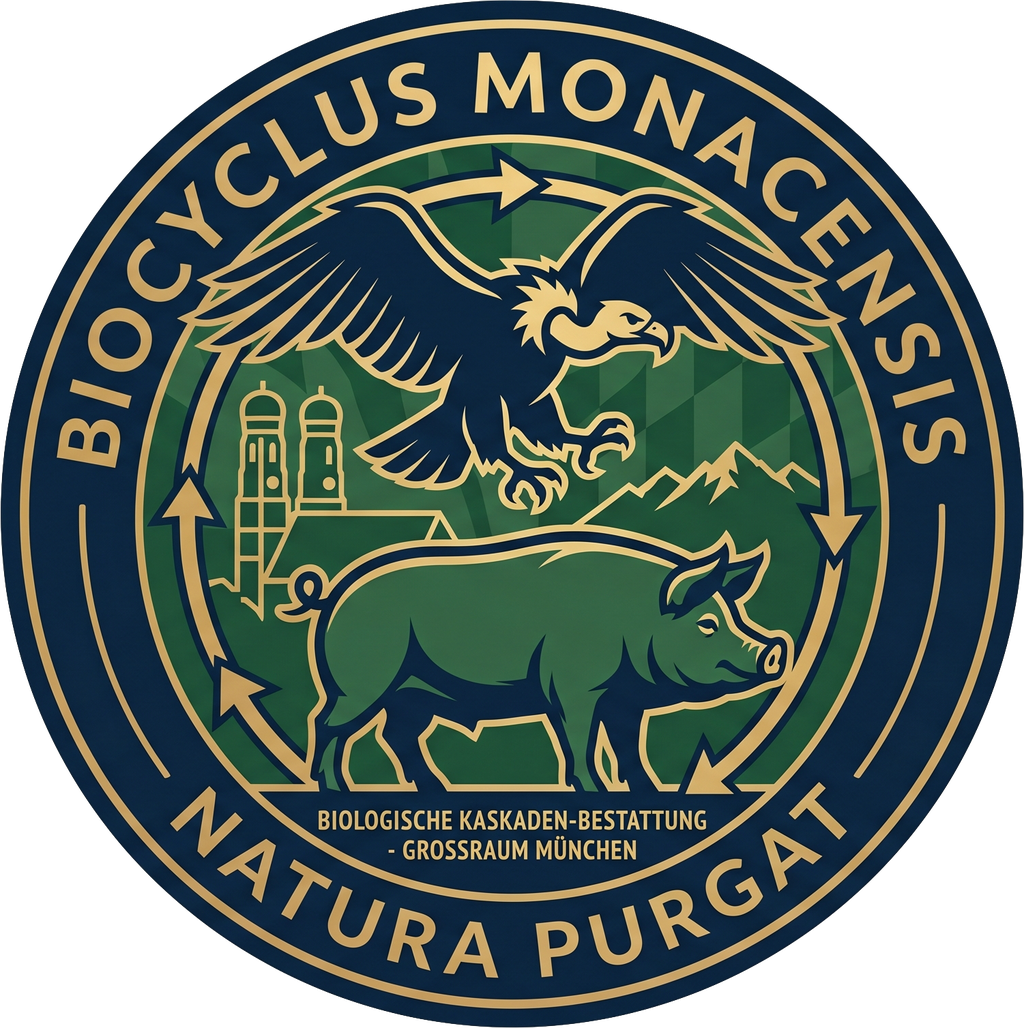
The emblem is a heraldic circle. In the upper arc: a Griffon Vulture with spread wings — stage 2, the purification. In the lower arc: a Sus scrofa, firmly stanced — stage 1, the conversion. At the center: the silhouette of the Frauenkirche set against the Alps, enclosed in a gilded arrow circle that runs from pig to vulture and back to soil. Color palette: Prussian Blue for seriousness, forest green for nature affinity, burnt gold for the dignity of the cycle. Deliberately no skeleton iconography, no scythe, no urn — we distance ourselves visually from the traditional burial industry.
Biocyclus Monacensis is Latin for „Munich bio-cycle"; Monacensis is the Latinized form of the Munich adjective (cf. Monachium, Monaco di Baviera). The motto Natura Purgat means „Nature purges." We chose Latin because it generates an institutional gravity that a „Bio Loop Munich GmbH" would not. Latin also survives every spelling reform and every marketing-trend wave — fitting for a concept aimed at the cycle of eternity. As a side benefit, it reads markedly more convincingly in correspondence with the authorities.
No.
Merchandise
The only part of the Biocyclus that actually exists. Whoever buys here funds a real cause: the reintroduction of the Bearded Vulture in the Bavarian Alps — the one aspect of this project outside of the satire, and therefore the only reason this shop exists at all.

Snapback
Vulture in full wingspan. For those who keep the overview.
Apron
Robust, grease-resistant, hunger-resistant. For the doers.
Women's T-shirt
The full coat of arms. For those who wear the motto openly.
Every purchase supports the reintroduction of the Bearded Vulture (Gypaetus barbatus) in the Bavarian Alps — our endangered mascot, not our employee.